“Take Flight” with our Interactive Mural

Click on a bird in the mural to learn more

1 / 15

"Take Flight"
By Chuck Tingley

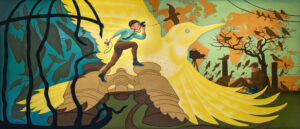
My vision is that the mural be a vibrant celebration for the Jamestown community and its visitors, honoring Roger Tory Peterson and bringing awareness to RTPI’s vital mission: inspiring others to see, study, and protect the beauty of the natural world.

— Chuck Tingley, Artist

“Take Flight” is a mural that celebrates the monumental legacy of Roger Tory Peterson. Rising five stories tall, it depicts Roger as an artist, an adventurer, a visionary best known for the Peterson Field Guide to the Birds. First published in 1934, it has sold upwards of 15 million copies worldwide and effectively sparked (and still fuels) the modern birding movement.

RTPI commissioned the mural from artist Chuck Tingley, whose public art projects may be found throughout Western NY – from Buffalo to Niagara Falls and now to Jamestown.

Unveiled in the summer of 2025, the mural is located on the Pearl City Arts Center, 120 Foundry Alley in downtown Jamestown, NY, kitty corner from the entrance to the National Comedy Center.

Click on the birds to learn more about them.

Funding for the mural project was provided by the Gebbie Foundation. Additional funding for the mural project was provided by the Chautauqua County 3% Occupancy Tax Grant program and the Barbro Osher Pro Suecia Foundation. Special thanks to Mark and Cynthia Carlson, owners of the Pearl City Arts Center, for providing the perfect “palette” for the mural.

2 / 15

Baltimore Oriole

Baltimore Oriole (Icterus galbula)

    • On the breast of the Baltimore Oriole, the pop of orange makes it visually stand out. With its black and white accented wings and a boldly patterned tail, the Baltimore Oriole is a recognizable bird. Males and females develop adult-like patterns over the first winter and spring. An Oriole can be found in open deciduous woods, elms, and shade trees. It is a common backyard bird, and one of the 1973 prints Roger Tory Peterson created for Mill Pond Press.
    • Roger had print runs with Mill Pond Press in 1955, 1957, 1968, 1973-1980, 1983, 1986, featuring not just birds but also some marine life, such as seals, and botanicals. RTPI received many of the prints in its collections from Mill Pond Press founder, Robert Lewin.
    • These non-field guide artworks were less didactic (not used as a teaching tool necessarily) and more aesthetic in a traditional “wall art” way, which allowed them to be easily reproduced as prints for people’s homes. They often showed up in dining rooms and kitchens, but were also reproduced on things like postcards, gift tags, decorative plates, lamps, etc. The commercialization of these artworks made Roger a household name and got his birds in front of eyes that wouldn’t necessarily be familiar with a field guide. It was an easy, accessible way of introducing birds into the average middle-class American home, and to get people thinking about birds.
    • A tale (tail?) of two orioles: Roger Tory Peterson famously created a Baltimore Oriole for one of his Mill Pond Press prints. These prints, smaller and more affordable than the larger-scale fine art prints, often graced dining rooms, living rooms, and kitchens. These prints were, of course, based on paintings Roger created out of gouache, watercolor, and pencil. However, the painting more or less matching the oriole in the print is…not quite right. The painting in the RTPI collection mimics the 1973 print of a Baltimore Oriole in many aspects. The Oriole perches on a branch surrounded by what appears to be green and yellowing grape leaves. Compared to the Baltimore Oriole print, though, this painting is of a much duller/darker tone. The orange on the breast is more of a reddish brown, and gone are the orange markings on the tail. The composition is also flipped, and the beak is closed in the lithograph version. Focusing on the feather coloring, it becomes clear that the print must have been supposed to feature an Orchard Oriole and was later switched for a Baltimore Oriole. Is this painting potentially an early version of the print? No original artwork matching the print exists in the RTPI Collection.

Roger Tory Peterson. Orioles. Gouache, watercolor, and pencil. Peterson Field Guide to Birds of North America, 2020, page 403. Image courtesy of Mariner Books.

3 / 15

Northern Cardinal

Northern Cardinal (Cardinalis cardinalis)

    • The Northern Cardinal is the #1 state bird in the United States. In Illinois, the Eastern Bluebird came in a close second, but school children voted the Northern Cardinal to be their state bird. The other states are Indiana, Kentucky, North Carolina, Ohio, Virginia, and West Virginia.
    • In addition to his field guide plates for the Northern Cardinal, Roger created several other artworks celebrating this beloved bird, easily recognizable for its bright red color and spikey crest. (The males, that is – female cardinals also have crests, but they are dusky brown, tinted with red.)
    • While Roger created a cardinal artwork for Mill Pond Press, he also created one much earlier for the Quaker State Lithographing Company. Between 1942-1952, Roger Tory Peterson began producing artwork for the Quaker State Lithographing Company, creating original large-scale paintings of life-size birds. The company founder, Gertrude Steinberg, produced thousands of copies of his artworks in a business partnership that allowed his artwork to be shown to untold numbers of people.
    • It all began in 1942 when Roger Tory Peterson visited Quaker State Lithographing Company in New York City with his recently completed Cardinals. The Company, founded in 1939 by Gertrude Gerstel Steinberg, was offered the painting for $75. Steinberg agreed, offering him royalties on the reproductions, and the prints were endorsed by the National Audubon Society. The print sold 10,000 copies in the first year and earned Peterson $2,500. Over the years, sixty-five of Roger’s artworks were reproduced into prints. These included Red-winged blackbirds, evening grosbeaks, bohemian waxwings, bobolinks, robins, summer tanagers, cedar waxwings, bluebirds, cardinals, rose-breasted grosbeaks, egrets, yellow-billed cuckoos, and flamingos.
    • Rather than displaying them in groups all facing the same way as he did in his field guides, Roger painted these birds into natural settings and posed them as portraiture. These were the works Roger liked creating most and felt were the best examples of his skill, which is why RTPI staff refer to the originals in the collection as the “masterworks”.
  • Where to see Northern Cardinals in CHQ
    • Peterson Preserve at RTPI
    • Audubon Community Nature Center
    • Chautauqua Watershed Conservancy

Roger Tory Peterson. Northern Cardinal. Gouache, watercolor, and pencil. Peterson Field Guide to Birds of North America, 2020, page 389. Image courtesy of Mariner Books


4 / 15

Osprey

Osprey (Pandion haliaetus)

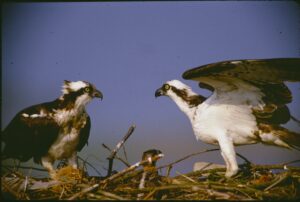
    • In 1954, Roger moved his family to Old Lyme, Connecticut to be near a large colony of Ospreys. That first year, he counted 150 Osprey nests in the estuary near the mouth of the Connecticut River. A decade later, the number of nests had dropped to 13. By 1974, there remained only one active Osprey nest in the entire state of Connecticut. Roger was among the first to suspect the culprit was DDT, a powerful insecticide that was in wide use against mosquitoes.
    • Along with Rachel Carson and many others, Roger advocated for the ban of DDT, which had decimated populations of Ospreys, Bald Eagles, Peregrine Falcons, Brown Pelicans, and many other species of birds. Their efforts met with a lot of resistance, but in 1972, President Richard M. Nixon signed into law the bill that banned DDT in the United States. Since then, populations of Ospreys and many other birds have steadily and significantly rebounded.
    • In 2021, RTPI honored Roger’s role in the banning of DDT by curating an exhibition entitled The Art of the Osprey. The exhibition featured photos of Ospreys taken by Roger when the future of Ospreys looked bleak. Roger’s photos were juxtaposed with photos taken by Jeanne Wiebenga of an Osprey pair successfully raising a chick, a mere 20 minutes from the Roger Tory Peterson Institute – a hopeful sign of the continuing recovery of Osprey populations throughout Western New York.

Roger Tory Peterson. Osprey. Gouache, watercolor, and pencil. Peterson Field Guide to Birds of North America, 2020, Page 197. Image courtesy of Mariner Books.


5 / 15

Barn Swallow

Barn Swallow (Hirundo rustica)

    • The Barn Swallow has deep, intense blue feathers, an orange chin, and a white breast. The tail feathers have two distinct points, which makes this Swallow’s silhouette easy to recall.
    • Roger created a Barn Swallow painting in 1973, which was also recreated by Joe Grice for an artist residency at the Roger Tory Peterson Institute in August of 2022. Joe Grice’s Barn Swallow print is for sale as a postcard in the Snowy Owl Museum.
    • Roger Tory Peterson was the very first scholar-in-residence at Fallingwater, Frank Lloyd Wright’s architectural masterpiece, located in Mill Run, PA. During his residency, he completed the artwork for his Field Guide to Mexican Birds. With our Artist-in-Residence program, the Roger Tory Peterson Institute aspires to follow in Roger’s footsteps by nurturing the next generation of nature artists who create Art that Matters to the Planet.
    • RTPI residents spend a week at RTPI with facilitated access to the Peterson Collection, inclusive of Roger’s original field guide art, fine art, films, slides and personal papers. Following the residency, artists create a body of work inspired by their time spent at RTPI, which is featured in a solo exhibition the following year. Recent artists in residence include Jennifer Anderson, Dennis Bowen, Lisa McLaughlin, Tina Mullen, Dorie Petrochko, Rosalie Haizlett, Joe Grice, Alex Warnick, and Robin Zefers Clark.

○   A delicate yet intricate black and white silhouetted drawing of a Barn Swallow was done by Roger for the Bird Watcher’s Anthology book published in 1957.

  • Where to see Barn Swallows in CHQ
    • Birding at RTPI
    • Audubon Community Nature Center
    • Chautauqua Watershed Conservancy

Roger Tory Peterson. Barn Swallow. Gouache, watercolor, and pencil. Peterson Field Guide to Birds of North America, 2020, page 281. Image courtesy of Mariner Books.

6 / 15

Great Green Macaw

Great Green Macaw (Ara ambiguous)

    • Roger Tory Peterson created this field plate of Great Green Macaws, which can be found in the book Field Guide to the Birds of Mexico and also The Art and Photography of Roger Tory Peterson.
    • Roger Tory Peterson also served as the first Scholar in Residence at Frank Lloyd Wright’s Fallingwater, where he finished his Field Guide to the Birds of Mexico. It is considered by many to be some of his finest work.
  • Where to see Great Green Macaws
    • Nicaragua, Honduras, Costa Rica, Panama, Colombia, and Ecuador

Roger Tory Peterson. Great Green Macaw. Gouache, watercolor, and pencil. Roger Tory Peterson: The Art and Photography of the World’s Foremost Birder, page 101. Image courtesy of the Easton Press.

7 / 15

Northern Flicker

Northern Flicker (Colaptes auratus)

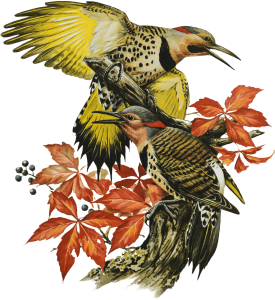
    • The Northern Flicker is Roger’s spark bird. What’s a spark bird? It’s when you have an experience with a bird that sparks a lifelong love of birds. Roger was 11 when he had an unexpectedly intimate encounter with a Northern Flicker. He was outside exploring, as usual, this particular time on Swede Hill, in his hometown of Jamestown, NY. He spied a bird on the side of a tree, but something wasn’t right – the bird wasn’t moving. Roger crept forward, reached out his finger, and actually touched the bird. Startled, the bird flew away in a burst of golden wingbeats. From that moment on, Roger was hooked.
    • At RTPI, we honor Roger’s spark bird experience in many ways, including a mural entitled “Flicker Moment.” Created by local artist Erin Ruffino in 2022, the central motif of the mural is a huge, stylized depiction of Roger’s Spark Bird. But there is a lot more to the mural. CLICK HERE to take a deep dive into the themes and the artistic process for creating the mural.
    • We honor Roger’s spark legacy, as well, as a founding sponsor for The Spark Bird Project. Led by RTPI Scholars-in-Residence, Dr. Jenn Lodi-Smith and Janet McNally, the Project is a first-of-its-kind social science research initiative to capture, understand, and share the spark bird experience, a phenomenon that is common to many of the nation’s 100 million birders.
    • Learn More
  • Where to see Northern Flickers in CHQ
    • Peterson Preserve at RTPI

Roger Tory Peterson. Northern Flicker. Gouache, watercolor, and pencil. Peterson Field Guide to Birds of North America, 2020, page 247.  Image courtesy of Mariner Books.

8 / 15

Eastern Bluebird

Eastern Bluebird (Sialia sialis)

    • The last state in the nation to name an official state bird, New York made a bold choice: the Eastern Bluebird. The year was 1970, and by that time the population of eastern bluebirds had declined nationwide by 90 percent. Among the leading causes was loss of habitat.
    • On the heels of the founding of the North American Bluebird Society in 1978, the New York State Bluebird Society got its start in 1982, with a mission “to increase Eastern Bluebird and other native cavity nesting bird populations in New York state through education, research, environmental advocacy, and a statewide nest box program.
    • In 1995, New York unveiled a custom “Protect Open Space” license plate featuring an eastern bluebird painted by native son, Roger Tory Peterson. Proceeds from the sale of the special plates go to the state’s Environmental Trust Fund, earmarked for open space protection. Most recently, RTPI established a Bluebird Trail, which includes several next boxes that are regularly monitored by volunteers. Each year, we report our next box data, along with more than a hundred individuals and organizations throughout the state.
    • Thanks to the collective effort of individuals, nonprofit organizations and government agencies, recovery of the Eastern Bluebirds has been a huge success. Today, the species is officially listed as a species of “Least Concern.”
    • LINKS:
      • Peterson Field Guide page for Eastern Bluebird
      • Roger’s Eastern Bluebird painting
      • All About Birds
      • eBird
  • Where to see Eastern Bluebirds in CHQ
    • Peterson Preserve Bluebird Trail at RTPI

Roger Tory Peterson. Eastern Bluebird. Gouache, watercolor, and pencil. Peterson Field Guide to Birds of North America, 2020, page 285. Image courtesy of Mariner Books.

9 / 15

Dovekie

Dovekie (Alle alle)

    • Roger recreated a dovekie in ink and watercolor for Penguins (1979), a book based on his favorite bird.
    • Dovekies can be found in the High Arctic, on coastal shelves, and sometimes even open areas in pack ice. They prefer to nest on coastal cliffs and forage for crustaceans, mollusks, and small fish by diving underwater. Dovekies are highly social birds, gathering in the thousands for both mating and for group flights.
    • Besides Greenland, Svalbard, and the Russian Arctic, this “bull bird” or “ice bird” can be found on the south coast of Newfoundland in numbers smaller than 1,000. In 1953, Newfoundland was the starting point of RTP and James Fisher’s Wild America journey, a 100-day, 30,000-mile journey undertaken by Roger Tory Peterson and his British counterpart, James Fisher. 2025 marked the 70th anniversary of the publication of Wild America, a classic in environmental literature and art. It has inspired generations of artists, conservationists, and birders, including Kenn Kaufman, who served the guest juror for the exhibition, Art that Matters to the Planet: Wild America.
    • As a boy, Kaufman was strongly influenced by the artwork and writing of Roger Tory Peterson. Wild America inspired Kaufman to pursue birds all over North America while he was still a teenager—an adventure later chronicled in his own classic work of environmental non-fiction, Kingbird Highway. An accomplished writer, artist, and leader of international birding tours, Kaufman has authored or co-authored 14 books about birds and nature, including his most recent book, The Birds That Audubon Missed.
    • Roger also observed the Dovekie on an Arctic cruise off Greenland. He described their great flocks that rise from the water like swarms of mosquitoes and drift away like smoke.
    • In Boston, gale winds pushed a Dovekie landward, and Roger observed the lone bird swimming in a flooded gutter.
  • Where to see Dovekies
    • On the East Coast, near bodies of water

Roger Tory Peterson. Dovekie. Gouache, watercolor, and pencil. Peterson Field Guide to Birds of North America, 2020, page 63. Image courtesy of Mariner Books.

10 / 15

Jay

COMING SOON

11 / 15

American Flamingo

American Flamingo (Phoenicopterus ruber)

    • The American Flamingo is one of six species of flamingo found throughout the world. The others are Greater Flamingo (world’s largest), Lesser Flamingo (smallest), Chilean Flamingo (found in South America), Andean Flamingo (found high in the Bolivian Andes of South America), and James’s Flamingo (the rarest flamingo species of them all).
    • Roger was the first to see and film all six species in their native habitats. To capture the James’s Flamingo on film, in 1957 Roger endured a strenuous month-long trek to Laguna Colorada, a shallow, intensely saline lake located in Bolivia at an elevation of 14,000. Suffering severe headaches, nosebleeds, and shortness of breath in the high-altitude terrain while slogging through mudflats sometimes hip-deep, Roger was able to film several species of flamingos, including the rare James’s. The following year, he premiered his film featuring all six flamingo species at the 1958 International Ornithological Congress, held in Helsinki.
    • In the finished film, Flamingos on Four Continents (1958), Roger Tory Peterson’s voice is absent. Flamingos on Four Continents is silent, as some of his major films were, because Roger used them for his Audubon Lecture Series. He would travel to various cities and give a lecture while the film played, so he himself served as the audio track. The Roger Tory Peterson Institute will soon be able to use the films for educational purposes and share them with countless audiences, in public viewings and even possibly on public television, or as DVDs for libraries to loan. No copies of the films other than the preservation copies of Wild America, Wild Africa, Wild Eden, and Flamingos on Four Continents exist outside of the RTPI archival collection. These films were chosen for preservation through the National Film Preservation Foundation.
    • Learn More
  • Where to see Northern Flamingos
    • Can be found near lagoons, coastal or inland lakes

Roger Tory Peterson. American Flamingo. Gouache, watercolor, and pencil. Peterson Field Guide to Birds of North America, 2020, page 171. Image courtesy of Mariner Books

12 / 15

Penguin

King Penguin (Aptenodytes patagonicus)

    • Second only to the Emperor Penguin in terms of size, the King Penguin is very similar in appearance. Kings have a longer, straighter bill and larger flippers.

Roger Tory Peterson considered the King Penguin to be his favorite species of bird. It also served as his nickname among birder friends. Once, when visiting the birds in the Bay of Isles in South Georgia, a “small delegation” followed Roger and the other explorers back to their small boat, with one bird considering, for a moment, whether it might hop in with them.

  • “Recently, when I was asked to choose a bird name as my pseudonym, I hesitated. Should it be Wandering Albatross or King Penguin? I finally decided on King Penguin, my favorite species in my favorite family of birds.”
  • In Penguins, Peterson brought together original pen and ink works, photography, and comparative factual narratives about his beloved family of birds. “There are seventeen kinds of penguins; I have seen and photographed them all in the course of more than a dozen expeditions to the Antarctic and sub-Antarctic in as many years. However, not all penguins are found in frigid surroundings; indeed, one, the least numerous, reaches the Equator in the Galapagos, a tropical archipelago that I have visited six times. I agree with George Gaylord Simpson; Penguins are habit-forming. I am an addict.”
  • Learn More
  • Where to see King Penguins
    • In comparison to other penguins, king penguins prefer warmer temperatures. They can be found on Sub-Antarctic islands such as South Georgia Island, Macquarie Island, Crozet Island, Heard Island, Marion-Prince Edward Island, Prince Edward Island, the Kerguelen Islands, and the Falkland Islands. They prefer flat, ice-free areas close to the shore.

Roger Tory Peterson. A Trio of Kings. Gouache, watercolor, and pencil. Roger Tory Peterson: Penguins, 1979, page 211.  Image courtesy of Mariner Books.

OR

Roger Tory Peterson. Penguins (End Papers for the Book). Gouache, watercolor, and pencil, 1979. Courtesy of the Peterson Estate. 2007.10.11.3

13 / 15

Mourning Dove

Mourning Dove (Zenaida macroura)

  • Mourning Doves are often seen in pairs when they are in mating season. They are monogamous and form bonds.
  • Roger Tory Peterson once commented on the Mourning Dove: it is the bird that can be found across the nation. If one were to drive across the country in summer, one would most likely see a Mourning Dove more frequently than any other bird.
  • Often seen in pairs, and are typically neutral gray with a blueish beak and ring around their eyes. They are known for their subtle cooing calls.
  • Roger Tory Peterson also sketched out this bird for a Morrell Co. Calendar, in addition to featuring it in various field guides.
  • Birds of Our Land prints—Produced in 1954 by Morrell & Co., these licensed reprints on medium-sized matte paper showcase the beauty of birds in their natural habitat. John Morrell and Co. was a meat packing business, and regularly commissioned artists to create art for advertisement materials (calendars, etc.), incl. the likes of artists such as NC Wyeth and Norman Rockwell. The pencil sketch for the Mourning Dove calendar page rests in the RTPI archives.
  • Learn More
  • Where to see Mourning Dove
    • Peterson Preserve at RTPI
    • Audubon Community Nature Center

Roger Tory Peterson. Mourning Dove. Gouache, watercolor, and pencil. Peterson Field Guide to Birds of North America, 2020, page 237. Image courtesy of Mariner Books.

14 / 15

Barn Owl

American Barn Owl (Tyto furcata)

    • One of Roger Tory Peterson’s masterworks is his Barn Owls. The painting was created for Mill Pond Press in 1975 to be reproduced as a commercial lithograph. It depicts two barn owls perching on a worn tree trunk with broken branches, surrounded by ivy. Barn owls are known to be monogamous, and ivy often symbolizes fidelity/fertility. With a heart-shaped white face, brown body, and piercing black eyes, the Barn owl has an elegant stature.
    • Roger’s Barn Owls can be found in the Snowy Owl Museum Store as a print, and on a mug—similarly to how Roger commercialized his work by selling postcards, prints, display plates, and even vases. At the Roger Tory Peterson Institute, we continue his legacy of disseminating his profound work.
    • A Barn Owl can also be found as part of the RTPI’s logo, a simple line drawing that calls back to the significant features of a Barn Owl. The Barn Owls painting has also been reproduced as one of the Roger Tory Peterson Institute’s main branding material images, and so can often be seen on brochures and other paraphernalia designed for the museum.
    • Learn More
  • Where to see the American Barn Owl
    • Bentley Nature Preserve

Roger Tory Peterson. American Barn Owl. Gouache, watercolor, and pencil. Peterson Field Guide to Birds of North America, 2020, page 223. Image courtesy of Mariner Books

15 / 15

Woodpecker

COMING SOON